About Course
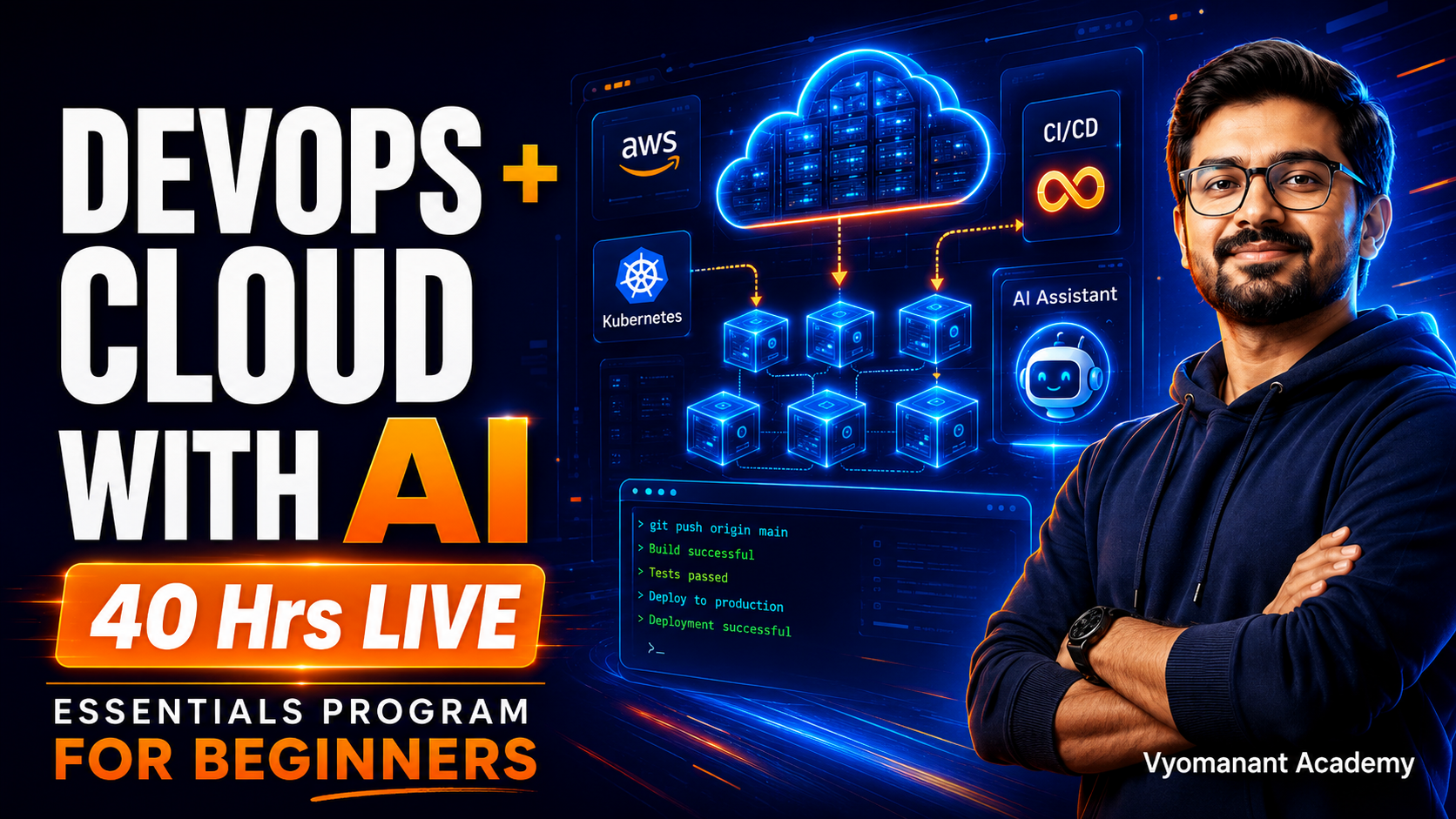
The DevOps & Cloud Essentials Program is a 40-hour live instructor-led training program designed for freshers, non-IT learners, students, and career switchers who want to start their DevOps and Cloud journey from zero.
This program helps learners build strong practical foundations in Linux, Git, GitHub, Jenkins, GitHub Actions, Docker, Kubernetes, CI/CD, Terraform, Ansible, and AWS through hands-on labs, real-world workflows, doubt support, and career roadmap guidance.
By the end of this program, learners will understand how modern DevOps teams build, automate, containerize, deploy, and manage applications using essential DevOps and Cloud tools.
#DevOpsCourse #CloudCourse #AIDevOps #DevOpsTraining #CloudTraining #AWS #Terraform #Kubernetes #Docker #Jenkins #GitHubActions #CICD #VyomanantAcademy
What Will You Learn?
- Build strong DevOps and Cloud foundations from zero.
- Configure a beginner-friendly Linux and DevOps practice environment.
- Use Git and GitHub for version control and project documentation.
- Create basic CI/CD pipelines using Jenkins and GitHub Actions.
- Containerize applications using Docker.
- Deploy beginner-level applications using Kubernetes.
- Configure basic AWS services for DevOps workflows.
- Implement simple Infrastructure as Code using Terraform.
- Automate server tasks using Ansible.
- Use AI tools safely for command explanation, troubleshooting, and code review.
Course Content
Module 0 — Course Orientation, Tools Setup and Lab Environment
-
Program Introduction
-
Complete Course Roadmap
-
System Requirements and Lab Readiness
-
Tools and Accounts Setup
-
Lab Workflow, Learning Material Access, and Assignment Submission
-
Class Schedule, Guidelines, and Next Steps
Module 1 — DevOps Foundations and SDLC
-
Introduction to Software Development & Engineering Practices
-
SDLC Models (Waterfall vs Agile vs DevOps)
-
Why DevOps in Modern Engineering
-
DevOps Lifecycle & Key Stages
-
CI/CD Concepts & Workflow Overview
-
Monolith vs Microservices Architecture
-
DevOps Tools Ecosystem Overview
-
Self Assessment
Module 2 — AI-Assisted DevOps Overview
-
Introduction to AI in the DevOps Era
-
What Are LLMs and How They Work
-
Types of AI Assistants for DevOps
-
How AI Assistants Support DevOps Workflows
-
Use of Generative AI for DevOps Tasks
-
Overview: AI for Troubleshooting, CI/CD, Monitoring and Logs
-
Prompting Basics for DevOps
-
How to Verify AI-Generated Commands and Scripts
-
AI Hallucination Risks
-
Do Not Paste Secrets into AI Tools
-
Human Validation: AI as Assistant, Not Replacement
-
Lab 0001 Install Terraform On Ubuntu And Verify Setup
Module 3 — Linux Administration and Shell Scripting
-
Linux Architecture & Distributions Overview
-
User & Group Management
-
Package Management (APT, YUM, DNF)
-
Process, Service & Systemctl Management
-
Networking Basics & SSH Configuration
-
Shell Scripting Fundamentals (Bash)
-
Variables, Loops & Conditional Statements in Scripts
-
Automating Tasks using Shell Scripts (Cron Jobs)
-
Linux Security Best Practices
-
Self-Assessment
Module 4 — Networking for Cloud and DevOps
-
Networking Fundamentals & Core Concepts
-
OSI vs TCP/IP Model
-
IP Addressing, CIDR & Subnetting
-
DNS, Name Resolution & Routing Basics
-
Ports, Protocols & Firewall Concepts
-
Load Balancing (L4 vs L7 Concepts)
-
Self-Assessment
Module 5 — Git and GitHub Version Control
-
Version Control Fundamentals & Git Concepts
-
Git Architecture & Workflow
-
Git Installation & Essential Commands (Clone, Commit, Push, Pull)
-
Branching Strategies (Feature, Release, Hotfix)
-
Merging & Handling Conflicts
-
GitHub Repositories & Collaboration Workflows
-
Pull Requests, Code Reviews & Team Collaboration
-
GitHub Actions Basics for CI Integration
-
Git Best Practices & Repository Management
-
Self-Assessment
Module 6 — AWS Cloud Infrastructure Core
-
Cloud Computing Fundamentals
-
AWS Global Infrastructure
-
IAM Users, Roles & Policies
-
EC2 Setup & Management
-
S3 Storage & Lifecycle Policies
-
VPC, Subnets & Routing
-
RDS Setup & Multi-AZ Design
-
DynamoDB & Use Cases
-
Amazon ECR for Container Images
-
Amazon ECS Overview
-
Amazon EKS Cluster Setup Overview
-
AWS CloudFormation Overview
-
Self-Assessment
Module 7 — Infrastructure as Code with Terraform
-
Introduction to Infrastructure as Code (IaC)
-
Terraform Architecture & Workflow
-
Providers, Resources & Data Sources
-
State Management & Remote Backends
-
Modules & Reusable Infrastructure Design
-
Provision AWS Infrastructure using Terraform
-
Variables, Outputs & Environment Management
-
Terraform Best Practices & Project Structure
-
Terraform Security & State Locking
-
Self-Assessment
Module 8 — Configuration Management with Ansible
-
Introduction to Configuration Management & Ansible
-
Ansible Architecture & Setup
-
Inventory Management & Ad-hoc Commands
-
Playbooks, Modules & Task Execution
-
Variables, Facts & Jinja2 Templating
-
Roles, Collections & Ansible Galaxy
-
Secrets Management with Ansible Vault
-
Real-world Automation Use Cases
-
Ansible Best Practices & Project Structure
-
Self-Assessment
Module 9 — CI/CD with Jenkins and GitHub Actions
-
CI/CD Fundamentals & Pipeline Architecture
-
Jenkins Installation & Architecture Overview
-
Jenkins Jobs, Pipelines & Declarative Syntax
-
GitHub Actions Workflows & Runners
-
Build Automation & Pipeline Best Practices
-
Artifact Management
-
Notifications, Webhooks & Integrations
-
CI/CD Security & Secrets Management
-
Self-Assessment
Module 10 — Containerization with Docker
-
Virtualization vs Containers
-
Docker Architecture & Components
-
Docker Installation & CLI Basics
-
Images, Containers & Lifecycle Management
-
Dockerfile & Image Build Optimization
-
Docker Networking (Bridge, Host, None)
-
Volumes, Bind Mounts & Storage Management
-
Docker Compose for Multi-Container Applications
-
Docker Registry & Image Management (Docker Hub / ECR)
-
Docker Best Practices & Security
-
Self-Assessment
Module 11 — Kubernetes Container Orchestration
-
Introduction to Kubernetes & Container Orchestration
-
Kubernetes Architecture: Cluster, Control Plane, Worker Node & Kubectl
-
Kubernetes Cluster Setup Overview: Minikube and Amazon EKS
-
Namespaces, Pods, ReplicaSets, Deployments & Services
-
StatefulSets, DaemonSets & Jobs
-
ConfigMaps, Secrets & Environment Variables
-
Kubernetes Networking: Services, Ingress & Service Discovery
-
Application Scaling, Auto-Healing & HPA Overview
-
Rolling Updates, Rollbacks & Deployment Strategies
-
Kubernetes Storage: Volumes, PV & PVC Overview
-
Kubernetes Security Basics: RBAC, Service Accounts & Secrets
-
Monitoring & Logging Overview: kubectl Logs, Events, Prometheus & Grafana
-
Self-Assessment
Module 12 — Monitoring and Observability
-
Monitoring Fundamentals & Observability Concepts
-
Prometheus Architecture & Data Model
-
Installing & Configuring Prometheus
-
Exporters (Node Exporter, Application Metrics)
-
Grafana Dashboards & Visualization
-
Metrics, Alerting & Alert Manager Setup
-
Logging Fundamentals & ELK Stack Overview
-
Centralized Logging (ELK / Loki)
-
Production Monitoring Strategy & SLOs
-
Self-Assessment
Module 13: Real-World DevOps Workflows and Projects
-
Real-World DevOps Workflow from Code to Deployment
-
Source Code to CI/CD Pipeline Flow
-
Docker-Based Application Delivery Flow
-
Cloud Deployment Workflow
-
Monitoring, Logs, and Troubleshooting Basics
-
Corporate DevOps Use Cases Introduction
-
Project: Deploy a Simple Application Using GitHub, CI/CD, Docker, and AWS
-
Project: Create a GitHub Portfolio Project with Documentation
Module 14: Mini Capstone and Career Readiness
-
Plan a Beginner DevOps Capstone Project
-
Build the Capstone Project Step by Step
-
Document the Project for GitHub Portfolio
-
Interview Preparation Basics
-
Resume and LinkedIn Project Presentation
-
DevOps and Cloud Career Final Roadmap
Student Ratings & Reviews